
Emory Warrant Check Starts at City Hall
Emory does not publish a public warrant search or roster in the official material reviewed. The first stop is the Municipal Court Clerk, who can look up the city's citation and explain the case route. The Police Department is a separate service contact, not a court status database.
The city court page and contact directory both point to City Hall. A court page shows a physical ZIP variation from the mailing address, so call before sending mail or traveling with a document that needs delivery.
Emory Warrant Checks
Call the Municipal Court Clerk at 903-473-2465 extension 103 or use the City Hall walk-in route during the court's listed weekday hours. Have the citation number and date ready. Ask whether the ticket is open, in FTA status, subject to a warrant or capias, or resolved, and which hearing or plea option applies.
- Use the citation or court notice to confirm the Emory Municipal Court case number.
- Call the court clerk and ask whether a warrant or FTA process issued.
- Ask what plea, hearing, payment, dismissal, or deferred-disposition option applies.
- If the answer involves custody or bond, call the serving office before appearing.
- Keep the receipt or court order and ask whether the warrant recall was sent to police.
Emory's Ten-Day Warrant Contact Rule
The Emory court page tells a person to appear or contact the court no later than ten days from the citation date. That is the city's published citation instruction, not a countywide deadline and not proof that a late case already has a warrant.
If the date has passed, call and ask whether the judge entered a new date or issued process. The page links drivers-safety-course, deferred-disposition, dismissal, and online payment routes, but staff must confirm what remains available in the individual case.
See the Emory court page for the local instruction.
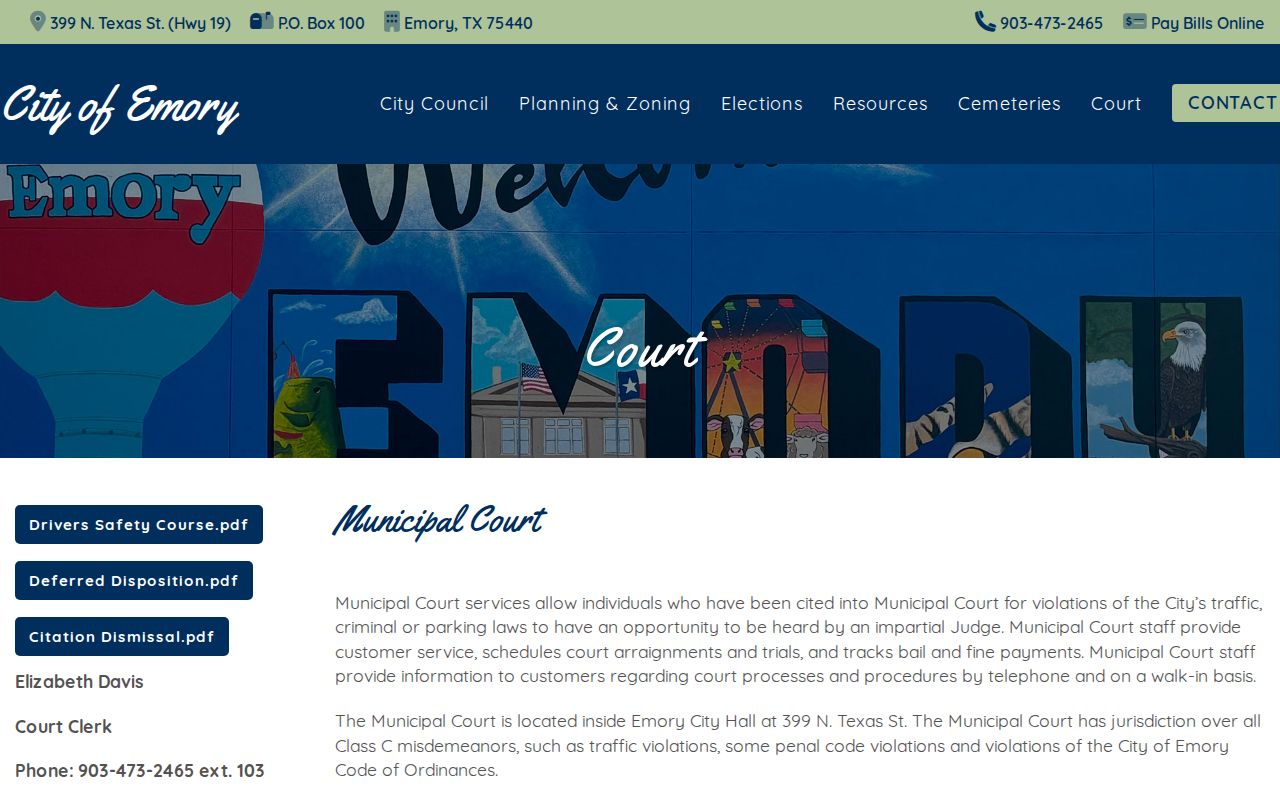
The court page provides the clerk route; it does not expose a public warrant search.
Policing and Courts in Emory
Emory Municipal Court is at City Hall, 399 N. Texas Street, and lists Clerk Elizabeth Davis at 903-473-2465 extension 103. The Police Department's official document gives 119 W. North Street and 903-474-9003. No Emory police warrant portal or public roster was located.
Emory Municipal Court
399 N. Texas Street, Emory, TX 75440
903-473-2465 ext. 103
Emory Police Department
119 W. North Street, Emory, TX 75440
903-474-9003
Emory Class C Warrant Cases Stay Municipal
The Emory court handles all Class C misdemeanors, traffic violations, some Penal Code violations, and City of Emory ordinance cases. Court staff schedule arraignments and trials, track bail and fine payments, and provide process information by phone and walk-in.
A city citation belongs to Emory Municipal Court even when the Rains County JP handles other traffic tickets nearby. Read the issuing court printed on the paper before choosing a payment link. A city clerk can explain procedure but cannot give legal advice.
Warrants in Emory: The Main Types
Emory municipal process most often arises from a city citation, an ordinance matter, or a missed court date. A separate probable-cause arrest warrant may involve a police investigation and a magistrate. A capias pro fine follows judgment and the court's fine-and-cost process. Ask the clerk for the exact document name.
| Warrant Type | How It Arises | Who Issues It |
|---|---|---|
| Traffic process | Unresolved Emory citation or missed city-court date | Emory Municipal Court |
| Ordinance process | Unresolved city-code case | Emory Municipal Court |
| FTA warrant | Missed appearance after required court notice | Emory Municipal Court judge |
| Arrest warrant | Probable-cause process after a criminal investigation | Magistrate or issuing court |
Emory Warrant Record Fields Follow the Citation
Emory's court and payment pages do not publish a sample warrant entry or a local number pattern. A clerk can use the citation number, name, and date to locate the file. Ask whether the court record shows a missed date, judgment, issue date, or officer return before acting on a status label.
Keep a note of the call date and the clerk's direction. If a payment, plea, or hearing changes the case, save the receipt or signed court order and ask whether the court has sent notice to police.
Emory Warrant Records: What They Show
A city file may contain a citation or cause number, offense, plea, appearance date, judgment, and warrant issue or return details. Emory does not publish a standard sample warrant number. The placeholder below names the number to request, not a real person's record.
| Citation number | Ask the Emory clerk |
|---|---|
| Offense and plea | City traffic, ordinance, or other Class C case information. |
| Issuing court | Emory Municipal Court for Emory citations. |
| Balance or bond | Ask for the current case-specific amount and approved option. |
| Warrant status | Confirm active, recalled, served, or closed with the clerk. |
Emory Police Warrant Contact and Court Recall
The Police Department's public contact is separate from the Municipal Court Clerk. The police document and city directory list police contact information, but neither offers a public warrant search. Use the clerk for citation status, court dates, and recall instructions; call police only when the court directs a service question there.
The city contact directory shows the court and police contacts together. It does not make the police department the keeper of the court's plea or payment record.
The Emory contact directory lists city, police, and court routes.

The directory helps route a call; the court itself confirms the case and any warrant recall.
Emory Warrants and Rains County
Emory Municipal Court and Police handle city matters; the Rains County Sheriff is a county service and custody contact, and Texas has no single public warrant portal joining every local court. The flow is Emory Municipal Court or Police → Rains County Sheriff when service is assigned → Texas DPS/OmniBase only for a qualifying FTA/FTP report. For the broader county court map, use the Rains County warrant records overview or the traffic warrant route.
Emory Payment Does Not Confirm Warrant Recall
Emory links a Pay Bills Online route and says staff track bail and fine payments. The public page does not say that clicking the payment link alone recalls a warrant or sends a same-day update to police. Ask the clerk whether the court has accepted the transaction and closed or recalled the process.
Keep the receipt, plea, order, or scheduled hearing note. If a status question involves custody, contact the Sheriff before going to a law-enforcement counter. The city clerk controls the municipal case, while the assigned officer's service record may update separately.
Accessing Emory Warrant Records
Texas Public Information Act requests go to the government office that holds the record, subject to confidentiality and law-enforcement exceptions. Ask Emory Municipal Court for a defined case or docket record. A public record does not include every sealed or juvenile detail, and a city clerk may ask for a cause or citation number.
Emory Records-Access Rules:
Texas Government Code Chapter 552 - request a defined record from the public office that holds it.
Code of Criminal Procedure Chapter 45A - sets municipal and justice-court warrant and docket rules.
Texas Family Code section 58.010 - limits release of child arrest-warrant records.